It's not just a perfume. It's a language. And to understand it, you have to know its ingredients.
When someone tries an Arabic perfume for the first time, the most common reaction is not...
"What is this? ": There is a density, a depth, a persistence that Western perfumery rarely achieves. A quality that stays on the skin for hours and on fabric for days.
The reason this happens lies in its ingredients.
Arab perfumery has a tradition spanning over a thousand years, predating the great French houses, modern distillation, and the glass bottle. For centuries, the Middle East was the center of the olfactory world: the silk routes carried resins, woods, and mosses worth their weight in gold. Today, the great Arab houses (Lattafa, Afnan, Armaf, Rayhaan, French Avenue) inherit this tradition and combine it with modern technology to create fragrances that compete with Western niche markets at a fraction of the price.
But what fundamentally distinguishes them are the ingredients. Here are the most important ones.
Oud: The Most Precious Ingredient in the World
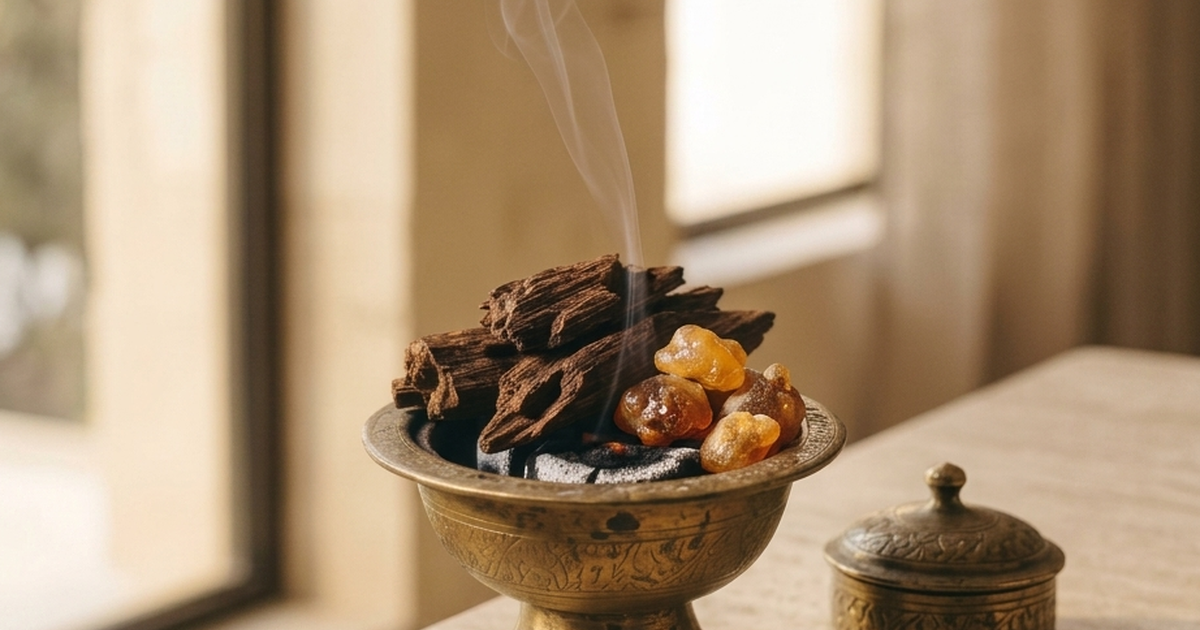
No other ingredient defines Arabic perfumery like oud - also called agarwood, aloeswood, or simply "wood" (عود) in Arabic.
Its origin is almost cinematic: oud is a dark resin that forms on certain trees when they are infected by a parasite or fungus. As the infection progresses, the tree produces a dark, aromatic resin in response to the attack. These trees belong to the genus Aquilaria , found mainly in Southeast Asia (Cambodia, Vietnam, Indonesia, India). Only 2% of Aquilaria trees are infected by the fungus that triggers resin production, which explains its extreme rarity and high price.
A low-quality extraction of resinous wood typically requires a minimum of 20kg to produce 12ml of oil. For context: some high-quality oud varieties are worth more than gold per gram.
What does it smell like? It's difficult to describe with a single word: oud is mystical, intoxicating, seductive, and of such diversity and complexity that words fail to capture its ever-evolving aroma. It can be sweet, floral, and balsamic, and at the same time bitter, spicy, and with notes of leather.
In Arabic perfumery, oud is often the base of the entire composition: the anchor around which everything else orbits. In Western perfumery, it is more often used as an accent, as a layer of depth. The difference in approach is enormous, and this explains why an Arabic perfume with oud smells so different from a European "oud."
Amber and Ambergris: The Confusion Worth Clearing Up
"Amber" is perhaps the most misunderstood ingredient in perfumery, because in reality it is two completely distinct ingredients with similar names.
Amber in perfumery is not a direct substance: it's a fantasy note, a carefully constructed accord made from other ingredients like labdanum, benzoin, and vanilla, capturing the essence of what amber might smell like, rather than a direct extraction from natural sources. It's warm, resinous, balsamic, with an enveloping sweetness. In Arabic perfumery, amber often appears in the base notes to create that warm and opulent sensation that is the genre's signature.
Ambergris (grey amber) is a completely different story, and far more fascinating. Usually described as one of the strangest natural phenomena in the world, ambergris is produced in the digestive system of whales. It forms as a result of a secretion process: in an attempt to protect their intestines from the sharp beaks of giant squid, whales naturally secrete this highly coveted substance.
Fresh ambergris has an unpleasant odor. Over time (exposed to sun, salt, and sea for years) it transforms into something extraordinary: some describe its sweet, musky scent as tobacco and aged whiskey, creating a warm and inviting aroma with a subtle animal quality that adds depth and intrigue.
Its most valuable property is its ability as a fixative: it amplifies and prolongs all the other notes of a fragrance, making it more persistent and complex. Today it is mainly replaced by Ambroxan: the synthetic molecule that we all recognize in Dior Sauvage, Bleu de Chanel, and hundreds of modern fragrances.
Musk: The Invisible Ingredient That Makes Everything Irresistible
Musk is the ingredient that can't be identified, but it makes a fragrance simply impossible to ignore. It's what creates the "second skin" sensation: that warm, soft, and intimately personal quality that some perfumes have and that makes those nearby want to get closer.
In its original form, musk came from the glands of an Asian deer (one of the most expensive natural substances in history). Today it is entirely synthetic in commercial perfumery, with dozens of variants available: white musk (clean, soft, floral), amber musk (warm, sensual), animal musk (more intense and provocative).
In Arabic perfumery, musk plays a structural role: it is present in almost all fragrances, often in higher concentrations than in Western perfumery. This explains why Arabic perfumes have that distinctive, atmospheric presence.
Rose: The Flower of Oriental Perfumery
The rose is the quintessential floral ingredient in Arabic perfumery, but not just any rose. Persian and Arabic tradition favors two specific varieties:
The Damask Rose (Rosa damascena), cultivated mainly in Bulgaria, Turkey, and Syria, is steam-distilled to produce one of the most expensive ingredients in perfumery. Rich, honeyed, slightly spicy. One kilogram of rose oil requires about three tons of petals harvested by hand at dawn, before the sun destroys the aromatic compounds.
The Taif Rose , cultivated in the Taif mountains of Saudi Arabia at an altitude of 1800 meters, is considered the most precious rose in the Arab world: more intense, sweeter, with a complexity that no other rose can replicate. It is a prestigious ingredient in major Arab houses and a marker of quality in a composition.
In Arabic perfumery, rose is assertive, rich, sometimes almost fleshy. Combined with oud and musk, it creates one of the region's most iconic signatures: oud rose , an olfactory family that lies at the heart of many of the most beloved fragrances in the Arab world.
Saffron: The Most Expensive Spice in the World
Saffron in perfumery doesn't smell exactly like the saffron popularized in cooking: it's drier, more mineral, with a warm, slightly earthy and exotic quality that immediately adds a dimension of oriental luxury to any composition.
It is a common ingredient in Arabic perfumery and appears in combinations with oud (to add dry spice to woody notes), with rose (to add warmth to floral notes), and with amber (to create rich and enveloping oriental compositions). In modern Western perfumery, saffron has become synonymous with exclusivity, as evidenced by its presence in fragrances costing over €300 from houses such as Xerjoff, Maison Francis Kurkdjian, or Roja Parfums. In Arabic perfumery, it is a regular ingredient even in affordable fragrances.
Frankincense and Resins: The Soul of the Orient
Frankincense is the resin of the Boswellia tree, native to the Middle East and East Africa. For millennia it was the most valuable ingredient in the world, transported along the same trade routes as gold and silk. Its scent is smoky, balsamic, and spiritual, having been used in religious ceremonies for thousands of years in civilizations ranging from Ancient Egypt to the Islamic Middle East.
In perfumery, frankincense adds a smoky, almost meditative depth, very different from the woody smoke of oud. It is cleaner, more ethereal, more sacred. It is frequently combined with amber, musk, and spice in deep oriental compositions that are the hallmark of winter Arabian perfumery.
The Arab Houses You'll Find at Essensio
Knowing the ingredients is just the beginning. Arabic perfumery only truly makes sense when you smell it, and at Essensio you have access to the most important houses of the genre, with all the convenience of a Portuguese service.
Lattafa: One of Dubai's largest houses, known for its extraordinary value for money. Khamrah (cinnamon, dates, amber and Bourbon vanilla) and Asad (spices, oud and woods) are two of the most viral Arabian perfumes of recent years and are available at Essensio.
Afnan: A Dubai-based company renowned for the quality of its raw materials and the sophisticated construction of its products. The Supremacy Collector's Edition is frequently compared to the Creed Aventus Absolu, with performance often surpassing it.
Armaf: An Indian house with global distribution that has democratized access to the DNA of luxury fragrances. Club de Nuit Intense Man has become the most famous dupe of Creed Aventus. Urban Elixir is the equivalent of Sauvage EDP, with superior performance in longevity and projection.
Rayhaan: One of the newest and most promising Arab houses, with an unmistakable bottle design and fragrances that blend Arab heritage with contemporary sensibility. Azul and Pacific Aloha (the two new summer 2026 releases) are two of the freshest and most versatile perfumes that have recently arrived at Essensio.
How to Explore Arabic Perfumery Safely
Arabic perfumery can be intimidating for those accustomed to light, fresh floral scents, and it's true that some fragrances are intense, dense, and made for specific climates and occasions. The best way to enter this world is gradually, with small doses.
That's exactly what Pockets Essensio are for: 1ml, 3ml and 5ml decants of the original perfumes, allowing you to try them before committing to a full bottle.
✅ 100% original, extracted directly from the brand's bottles.
✅ Available in 1ml, 3ml and 5ml
✅ Delivery within 24/48 hours to mainland Portugal
✅ Free shipping on orders over €30
Arabic perfumery is a millennia-old tradition that has finally arrived in Portugal with all the quality and accessibility it deserves.
Exploring Arabic perfumes at Essensio
→ Try it in Pocket format